If you have been filling up your tank recently and wondering why your mileage feels slightly lower, you are not alone. Millions of Indian drivers are asking the same question as E20 fuel quietly replaced regular petrol at most pumps by 2025. So, is ethanol really worse for your mileage? Is it cheaper than petrol? And most importantly, is ethanol petrol bad for your car? In this article, we break down everything you need to know about ethanol vs petrol mileage, price, efficiency, and real-world performance, so you can make a smarter decision every time you refuel.
Contents
- 1 What Is Ethanol and How Is It Different from Petrol?
- 2 Ethanol vs Petrol Mileage: How Much Does It Actually Drop?
- 3 Ethanol vs Petrol Mileage Per Litre: Real Numbers Explained
- 4 Ethanol vs Petrol Calorific Value and Energy Density
- 5 Is Ethanol Cheaper Than Petrol in India?
- 6 Ethanol vs Petrol Efficiency: Which One Actually Wins?
- 7 Is Ethanol Petrol Bad for Your Car?
- 8 Ethanol vs Petrol Emissions: Which Fuel Is Greener?
- 9 India’s E85 Fuel Launch: What You Need to Know Right Now
- 10 E85 Fuel Price in India and Mileage Impact
- 11 Which Flex-Fuel Vehicles Support E85 in India?
- 12 E100 Ethanol Fuel in India: The Next Frontier
- 13 India’s Full Ethanol Roadmap: From E10 to E100
- 14 Ethanol vs Petrol: Which Is Better for Indian Roads?
- 15 Tips to Maintain Good Mileage on Ethanol-Blended Petrol
- 16 FAQs
What Is Ethanol and How Is It Different from Petrol?
Before we compare ethanol vs petrol, it helps to understand what each fuel actually is. Petrol, also called gasoline, is a fossil fuel refined from crude oil. Ethanol, on the other hand, is a renewable alcohol-based fuel made from plant materials like sugarcane, corn, and maize. In India, the government has been aggressively pushing ethanol blending, starting with E10 (10% ethanol, 90% petrol) and now moving to E20 (20% ethanol, 80% petrol) across the country.
Moreover, ethanol burns cleaner than pure petrol. It contains oxygen within its own molecular structure, which helps the engine burn fuel more completely. However, the key trade-off is energy density. Ethanol carries only about 65 to 67% of the energy that petrol holds per litre, which directly affects how far your vehicle can travel on a full tank. According to the IEA Advanced Motor Fuels data, the heating value of ethanol is around 21 MJ/l compared to petrol’s approximately 32 MJ/l.
Ethanol vs Petrol Mileage: How Much Does It Actually Drop?
This is the question most drivers care about most. The honest answer is yes, ethanol blends do reduce mileage, but the actual drop depends on your vehicle, engine calibration, and the blend percentage you are using.
According to the Nayara Energy blog, vehicles not designed specifically for higher ethanol blends typically see a mileage drop of around 3 to 4% with E10, and slightly more with E20. Meanwhile, the US Department of Energy’s fueleconomy.gov confirms that flex-fuel vehicles running on E85 see roughly 15 to 27% fewer miles per gallon compared to regular gasoline.
In India specifically, the Society of Indian Automobile Manufacturers (SIAM) stated that E20 fuel reduces mileage by just 2 to 4% on most vehicles. Additionally, a real-world test conducted by Autocar India across four popular cars, including naturally aspirated and turbocharged models, found that mileage losses were closer to manufacturer estimates than to the alarming figures circulating on social media.
| Fuel Type | Ethanol Content | Mileage Impact | India Status |
|---|---|---|---|
| Pure Petrol (E0) | 0% | Baseline (100%) | Phasing out |
| E10 | 10% | 3 to 4% drop | Phased out |
| E20 | 20% | 4 to 6% drop | Nationwide standard |
| E85 | 85% | 25 to 35% drop | Launched June 2026 |
| E100 | 92 to 94% | 30 to 40% drop (estimated) | Pilot at 183+ outlets |
Ethanol vs Petrol Mileage Per Litre: Real Numbers Explained
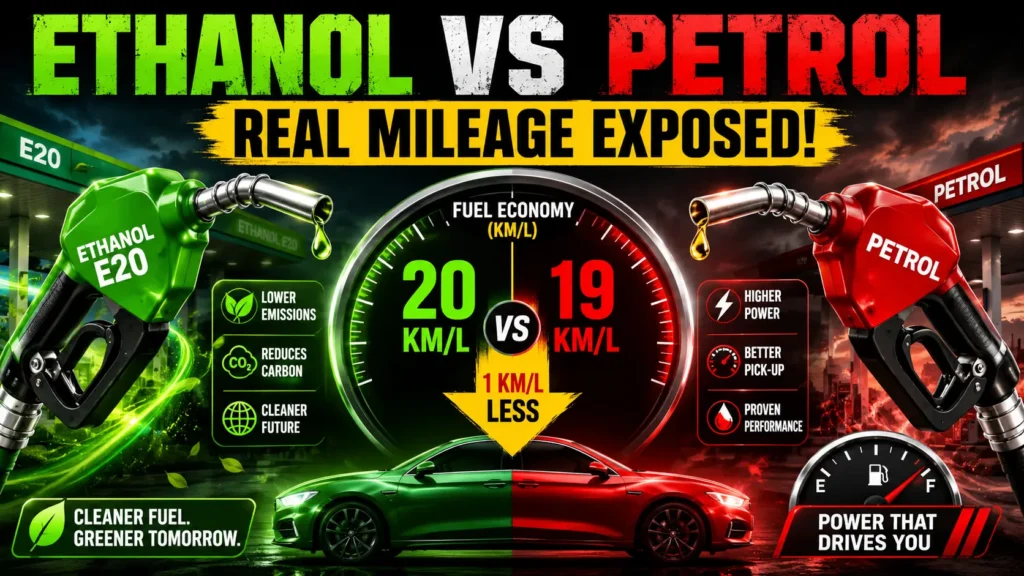
To understand ethanol vs petrol mileage per litre, you need to look at energy density. Petrol carries around 32 MJ per litre, while ethanol offers only about 21 MJ per litre. Therefore, if your car gives 20 km/l on pure petrol, you can expect roughly 19 to 19.2 km/l on E10 and around 18.8 to 19 km/l on E20 in real-world driving.
However, the mileage loss is not always as severe as the math suggests. This is because ethanol has a higher octane rating than petrol. According to bioethanol research data, ethanol’s higher octane number gives it better antiknock characteristics, which can actually improve combustion efficiency in well-calibrated engines. Consequently, some modern E20-ready cars compensate for the energy deficit through better timing and injection tuning.
In addition, the Automotive Research Association of India (ARAI) found that E20 gives better acceleration and ride quality, and lowers carbon emissions by 30% compared to E10, even if absolute fuel economy drops slightly.
Ethanol vs Petrol Calorific Value and Energy Density
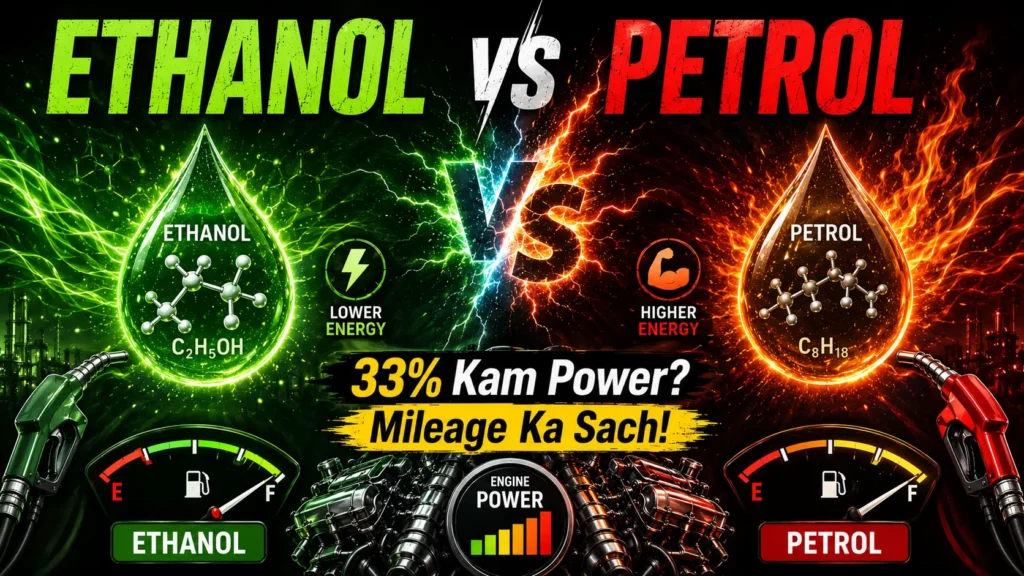
The calorific value is where ethanol falls clearly behind petrol. According to Sustainability Shiksha, ethanol carries a gross calorific value of approximately 29,700 kJ/l, which is roughly 33% less than that of petrol. In simpler terms, you need more ethanol to produce the same amount of energy that a litre of petrol gives you.
Moreover, petrol holds around 43.2 MJ/kg in energy, while ethanol holds only about 26.9 MJ/kg. This is the fundamental reason why your fuel economy dips with higher ethanol blends. However, ethanol compensates partly through its oxygen content of about 35%, which supports cleaner combustion at relatively lower temperatures.
| Property | Ethanol | Petrol (Gasoline) |
|---|---|---|
| Calorific Value (MJ/kg) | 26.9 MJ/kg | 43.2 MJ/kg |
| Energy Density (MJ/l) | ~21 MJ/l | ~32 MJ/l |
| Octane Number (RON) | ~108-110 | ~91-95 |
| Oxygen Content | 35% | 0% |
| Density (kg/l) | 0.79 kg/l | ~0.74 kg/l |
| CO2 Emissions | Lower lifecycle | Higher lifecycle |
Is Ethanol Cheaper Than Petrol in India?
This is where things get interesting. Many people assumed that since ethanol is made from locally grown crops, it should cost less than imported petrol. However, the reality in 2025 is quite different. According to the Business Standard, the Ministry of Petroleum and Natural Gas confirmed that the average procurement price of ethanol, including transportation and GST, has now crossed the cost of refined petrol at Rs 71.32 per litre in 2024-25.
Furthermore, Business Today reports that maize-based ethanol prices jumped from Rs 52.92 per litre in 2021-22 to Rs 71.86 per litre in 2024-25. Despite this rise, the government has kept the blending mandate active because the program supports farmers, reduces crude oil imports, and cuts pollution. From 2014-15 to July 2025, ethanol blending saved Rs 1.44 lakh crore in foreign exchange and cut CO2 emissions equal to planting 30 crore trees.
So, while ethanol itself is now costlier to procure than petrol, the blended fuel price at the pump remains regulated, and you are not directly paying for the raw ethanol cost difference every time you refuel.
Ethanol vs Petrol Efficiency: Which One Actually Wins?
When it comes to pure energy efficiency, petrol wins on a per-litre basis. However, efficiency is not just about how many kilometres you get per litre. It also includes combustion quality, engine wear, and environmental cost. On all of those fronts, ethanol has real advantages.
According to Fleet News UK, a study by Trakm8 found that premium fuels with lower ethanol content deliver approximately 10% more range compared to standard E10 blends. On the other hand, ethanol’s higher heat of vaporization actually reduces intake manifold temperatures, which increases air-fuel mixture density and improves volumetric efficiency in modern engines.

In addition, the Green Car Reports test found that non-ethanol gasoline can boost mileage by nearly 10% compared to E10 blends in older vehicles. However, newer E20-ready cars are tuned to minimize this gap significantly.
Is Ethanol Petrol Bad for Your Car?
One of the most searched questions is whether ethanol petrol is bad for your car. The short answer is no, not if your vehicle is designed or compatible with the blend you are using. However, older vehicles face a different situation.
The Deccan Herald reported that an inter-ministerial committee, along with studies from Indian Oil Corporation, ARAI, and SIAM, found no significant negative effects on vehicle performance, metal compatibility, or plastic compatibility even in legacy vehicles using E20. Moreover, there were no issues with drivability or startability in the field trials.
However, ethanol is known to be mildly corrosive to rubber seals, older fuel lines, and carburetors found in pre-2010 vehicles. Therefore, if you own a vintage or older bike or car, it is worth consulting your manufacturer before switching to E20 regularly. Vehicles manufactured after April 2023 in India are very likely E20-ready from the factory.
| Vehicle Type | E10 Compatibility | E20 Compatibility |
|---|---|---|
| Post-2023 Cars and Bikes | Fully compatible | Fully compatible |
| 2010 to 2023 Models | Mostly compatible | Check manufacturer |
| Pre-2010 Older Vehicles | Caution advised | Not recommended |
| Vintage and Classic Cars | Risk of corrosion | Avoid |
Ethanol vs Petrol Emissions: Which Fuel Is Greener?
On emissions, ethanol clearly wins. According to fueleconomy.gov, ethanol use in the US grew from about 1.7 billion gallons in 2001 to over 14 billion gallons in 2024, largely because it burns cleaner than gasoline. In India, the government’s blending program has already cut carbon emissions by 74 billion kilograms, which is equivalent to planting 30 crore trees, according to Advanced BioFuels USA.
Moreover, ethanol’s oxygen content supports cleaner combustion, which reduces unburnt hydrocarbons and particulate matter. Consequently, cities with higher ethanol blending tend to report lower vehicular air pollution. Additionally, because ethanol comes from crops that absorb CO2 while growing, its lifecycle carbon footprint is much lower than fossil-based petrol.
India’s E85 Fuel Launch: What You Need to Know Right Now
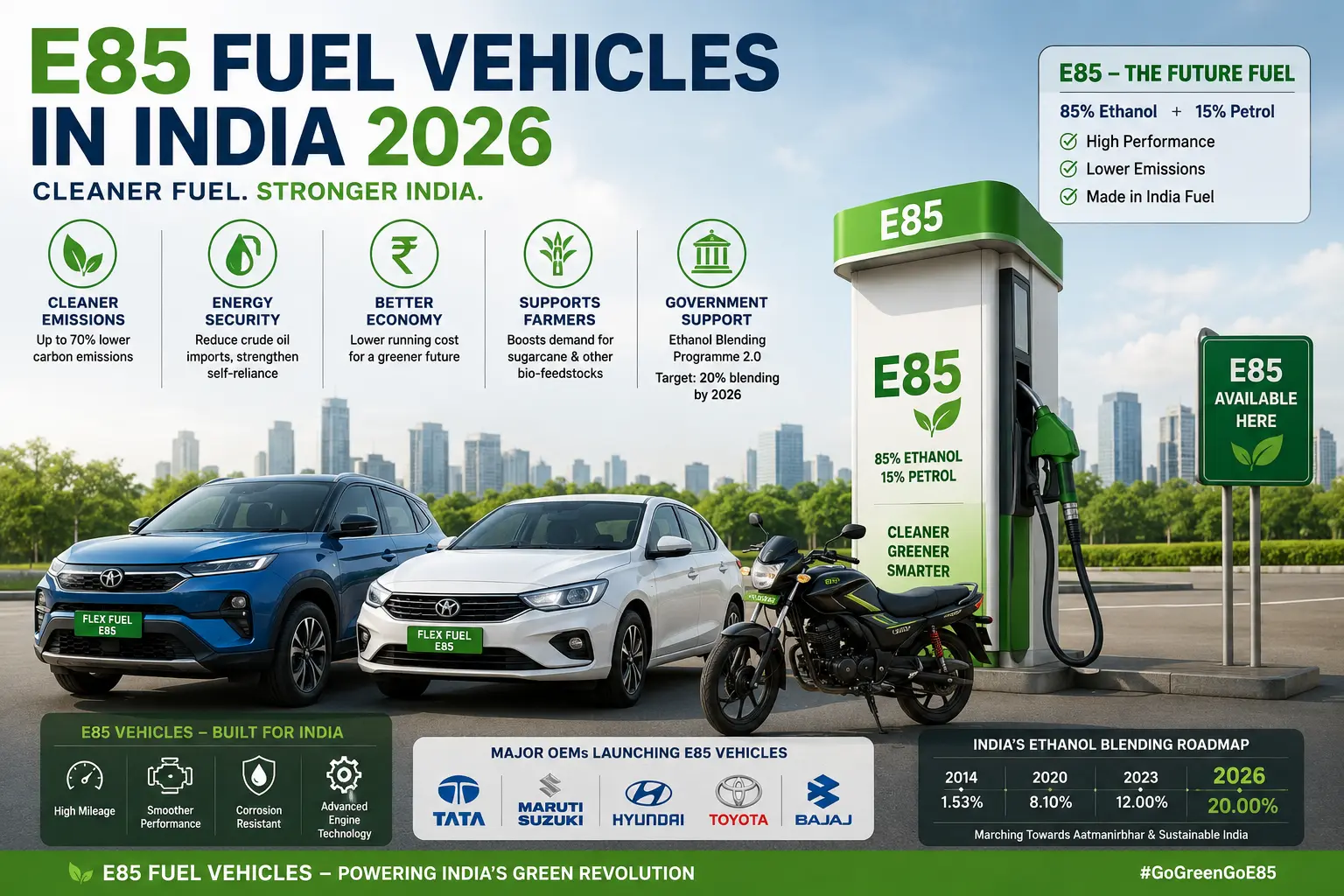
India’s ethanol journey did not stop at E20. On World Environment Day, June 5, 2026, Union Minister Hardeep Singh Puri officially launched E85 fuel in India at an Indian Oil outlet on Pusa Road, New Delhi. This is a landmark moment for the country’s clean fuel mission, and it signals that the transition from E20 to much higher ethanol blends is already underway. According to Sarkaritel, E85 is currently available at 48 PSU oil retail outlets, with the government planning to expand this to 500 outlets by December 2026 and approximately 5,000 pumps across India by the end of 2027.
So what exactly is E85? As the name suggests, E85 contains 85% ethanol and 15% petrol. Moreover, it is designed exclusively for flex-fuel vehicles (FFVs), which are specially built to run on any ethanol blend ranging from E20 all the way up to E100. Therefore, if you own a regular petrol car or even an E20-compliant car, you cannot use E85. Putting E85 into a non-flex-fuel engine can damage the fuel system, corrode rubber seals, and cause serious engine failure. There is currently no approved conversion kit available in India.
E85 Fuel Price in India and Mileage Impact
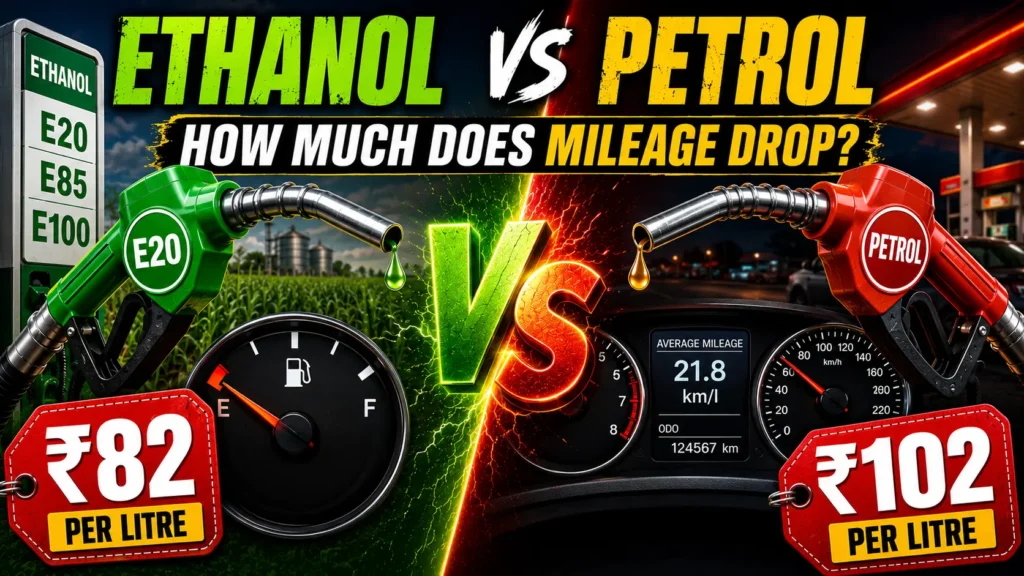
At first glance, E85 looks like a great deal on price. According to CarBike4U, E85 launched at Rs 82.12 per litre in Delhi, which is around Rs 20 cheaper per litre than regular E20 petrol priced at Rs 102.12 per litre. However, the savings story is more nuanced when you factor in mileage.
Because ethanol carries significantly less energy than petrol, E85 fuel mileage drops considerably compared to regular petrol or E20. According to DriveSpark, flex-fuel vehicles running on E85 can expect roughly 25 to 35% lower mileage compared to E20. In practical terms, a car that gives 20 km/l on regular petrol will drop to around 14 to 16 km/l on E85, and a bike giving 70 km/l on petrol may return only 49 to 56 km/l on E85.
Consequently, the lower pump price does not fully offset the higher fuel consumption. According to VahanBazaar, E85 would need to be priced at around Rs 68 to 70 per litre when E20 is at Rs 105 per litre for the per-kilometre running cost to truly break even. Additionally, the GST Council is reportedly discussing a reduction in E85 GST from 18% to 5%, and if that happens, the economics could shift significantly in favour of E85 for flex-fuel vehicle owners.
| Fuel | Price (Delhi, June 2026) | Mileage Drop vs Petrol | Who Can Use It |
|---|---|---|---|
| Pure Petrol (E0) | Phasing out | Baseline | All petrol vehicles |
| E20 | Rs 102.12/litre | 4 to 6% | Post-April 2023 vehicles |
| E85 | Rs 82.12/litre | 25 to 35% | Flex-fuel vehicles only |
| E100 / Ethanol100 | Pilot stage | 30 to 40% (estimated) | Dedicated E100 vehicles |
Which Flex-Fuel Vehicles Support E85 in India?
As of June 2026, the number of E85-compatible vehicles on sale in India is still quite small, but it is growing quickly. On the two-wheeler side, Hero MotoCorp launched the Splendor+ Flex Fuel at Rs 82,710 and the HF Deluxe Flex Fuel at Rs 72,792 (ex-showroom Delhi), both powered by a 97.2cc engine with a revised ECU and upgraded fuel system. According to DriveSpark, both bikes go on sale in Delhi and select Maharashtra regions from July 2026 and support blends from E20 to E85. Moreover, Suzuki had already launched the Gixxer 250 SF Flex Fuel at the 2025 Bharat Mobility Global Expo.
On the four-wheeler side, the Maruti Suzuki Wagon R Flex Fuel prototype has been showcased and is currently available mainly for commercial buyers. Additionally, Tata Motors is preparing to introduce its first flex-fuel passenger vehicle by late 2026 or early 2027, while Toyota’s Innova Hycross flex-fuel prototype, first unveiled by Minister Nitin Gadkari in 2023, combines hybrid technology with E85 compatibility. According to CarhP India, the Maruti Fronx Flex Fuel is also expected to launch at around Rs 9 to 10 lakh, with its 1.2-litre K12 engine reworked to support blends from E20 up to E85.
E100 Ethanol Fuel in India: The Next Frontier
Beyond E85, India is also moving toward E100, which is essentially near-pure ethanol fuel. Union Minister Hardeep Singh Puri had already launched Ethanol100 as an alternate auto fuel on March 15, 2024. According to News on Air, Ethanol100 is a blend of 92 to 94% ethanol, 4 to 5% motor spirit to colour the flame, and 1.5% co-solvent higher saturated alcohol. As part of a pilot initiative, Indian Oil rolled out Ethanol100 at 183 retail outlets across ethanol-rich states including Uttar Pradesh, Maharashtra, Karnataka, Tamil Nadu, and Delhi.
The environmental benefits of E100 are remarkable. According to the government’s own data, Ethanol100 produces around 63% lower greenhouse gas emissions on a well-to-wheel basis compared to regular petrol. However, the challenge with E100 is that it requires dedicated vehicles with significant engine modifications, including higher compression ratios, specific valve timing, and direct injection systems. Additionally, separate storage tanks and dedicated dispensing equipment are needed at fuel stations, which makes the infrastructure rollout considerably more complex than E20.
According to TopNews India, Union Minister Nitin Gadkari has formally approved new rules recognising E85 and E100 fuels, signalling India’s regulatory commitment to 100% ethanol-powered mobility in the long run. The government’s ambitious target is nationwide availability of both E85 and E100 between 2026 and 2030, though industry experts note that widespread E100 adoption will take longer due to vehicle engineering and infrastructure challenges.

India’s Full Ethanol Roadmap: From E10 to E100
To understand where India is headed, it helps to look at the full picture of the country’s ethanol blending journey. India started with modest E10 blending, accelerated to E20 ahead of schedule by July 2025, and has now launched E85 commercially in June 2026. Meanwhile, E100 pilots are already running in select states. According to Manorama Yearbook, the expansion of E85 infrastructure is expected to help raise India’s overall ethanol blending level to nearly 26% by 2030-31.
Brazil offers the clearest global reference point for where India is heading. Brazil commonly sells a 27% ethanol blend and recently announced plans to increase the percentage further. According to DriveSpark, initial E85 trials in India could begin more broadly as early as December 2026, following the Brazil model of widespread flex-fuel adoption.
| Phase | Fuel | Status (June 2026) | Target |
|---|---|---|---|
| Phase 1 | E10 | Completed and phased out | Done |
| Phase 2 | E20 | Nationwide rollout complete | Achieved July 2025 |
| Phase 3 | E85 | Launched at 48 outlets in June 2026 | 5,000 pumps by Dec 2027 |
| Phase 4 | E100 | Pilot at 183+ outlets | Nationwide by 2028-30 |
Ethanol vs Petrol: Which Is Better for Indian Roads?
For Indian drivers in 2025 and beyond, the answer depends on your vehicle’s age and your priorities. If you own a newer car or bike made after 2023, E20 is completely safe and will barely affect your daily mileage by more than 2 to 4%. On the other hand, if you drive an older vehicle, you may notice a slightly bigger mileage drop and should check compatibility before using E20 regularly.
From a broader perspective, ethanol blending is clearly better for the country. It reduces India’s dependence on crude oil imports, supports sugarcane and maize farmers, and cuts air pollution significantly. Additionally, with the government targeting E20 nationwide by 2025-26, this is not a trend you can avoid but rather one you need to understand and prepare for.
| Factor | Ethanol (E20) | Pure Petrol |
|---|---|---|
| Mileage | Slightly lower (2-6%) | Higher baseline |
| Price (pump) | Regulated, similar | Standard market price |
| Emissions | 30% lower CO2 | Higher CO2 |
| Octane Number | Higher (better knock resistance) | Lower |
| Engine Wear | Safe for E20-ready vehicles | Standard compatibility |
| Availability | Nationwide by 2025-26 | Phasing out |
| Environmental Impact | Renewable, cleaner | Fossil fuel, polluting |
Tips to Maintain Good Mileage on Ethanol-Blended Petrol
Even though ethanol blends slightly reduce mileage, you can take steps to keep your fuel economy as close to normal as possible. First, always keep your tires inflated to the correct pressure, since under-inflated tires increase fuel consumption regardless of fuel type. Second, follow your vehicle’s regular service schedule, because a clean air filter and fresh spark plugs help your engine burn ethanol blends more efficiently. Third, avoid aggressive acceleration and hard braking, since smooth driving habits make a bigger difference to mileage than the fuel type alone. Additionally, if you own a modern E20-ready vehicle, trust the factory calibration and avoid seeking out old-stock pure petrol, since your engine is already tuned to work best with the blended fuel.
Moreover, according to Milex Global, vehicles manufactured after April 2023 in India are likely E20-ready and should run efficiently on the new standard fuel without any special maintenance.
FAQs
Does ethanol reduce mileage compared to pure petrol?
Yes, ethanol-blended petrol does reduce mileage slightly because ethanol has lower energy density than petrol. With E10 fuel, you can expect a drop of around 3 to 4%, while E20 may reduce mileage by 4 to 6% depending on your vehicle type and engine calibration. Newer E20-ready cars are tuned to minimize this gap.
Is ethanol cheaper than petrol in India?
As of 2024-25, ethanol procurement is actually costlier than petrol, with the average procurement price reaching Rs 71.32 per litre including transportation and GST, according to the Ministry of Petroleum. However, the government maintains the blending mandate for energy security, farmer income, and environmental benefits.
Is ethanol petrol bad for your car?
For vehicles manufactured after April 2023, E20 fuel is completely safe and compatible. Older vehicles, especially pre-2010 models, may experience mild corrosion in rubber seals and fuel lines. Studies by ARAI and SIAM found no significant engine damage or abnormal wear even in legacy vehicles using E20 fuel.
What is the calorific value of ethanol vs petrol?
Ethanol has a calorific value of approximately 26.9 MJ/kg and about 21 MJ/l, while petrol holds around 43.2 MJ/kg and approximately 32 MJ/l. This means ethanol carries about 33% less energy per litre than petrol, which is why higher ethanol blends result in slightly lower fuel economy.
Which is better for the environment, ethanol or petrol?
Ethanol is significantly better for the environment. India’s ethanol blending program has already cut carbon emissions by 74 billion kilograms, equal to planting 30 crore trees. E20 fuel produces about 30% lower CO2 emissions compared to E10, while E100 reduces greenhouse gas emissions by around 63% on a well-to-wheel basis compared to regular petrol.
What is E85 fuel price in India and can my car use it?
E85 fuel was officially launched in India on June 5, 2026, at Rs 82.12 per litre in Delhi, which is around Rs 20 cheaper than regular E20 petrol. However, E85 can only be used in specially built flex-fuel vehicles (FFVs). Standard petrol cars and even E20-compatible cars cannot use E85. Using it in a non-FFV can cause serious engine and fuel system damage.
What is E100 fuel and when will it be available across India?
E100 is near-pure ethanol fuel, typically a blend of 92 to 94% ethanol with a small amount of motor spirit and co-solvent. Union Minister Hardeep Singh Puri launched Ethanol100 in March 2024, and it is currently available at over 183 pilot outlets across UP, Maharashtra, Karnataka, Tamil Nadu, and Delhi. Nationwide availability is expected between 2028 and 2030 as part of India’s long-term clean fuel roadmap.
Sources used in this article: fueleconomy.gov | Autocar India | Business Standard | Nayara Energy | IEA AMF | Malay Mail / SIAM | Deccan Herald / ARAI | Sarkaritel / E85 Launch | DriveSpark | CarBike4U | News on Air / E100 | TopNews India
Stay tuned to AutoRadar for the latest news and updates like this – we bring you automobile news every day.